
LLM Critiques
The Thinkers Mapping Human Intelligence in the Age of AI
A Comparative Guide to the Most Important Philosophical Voices
Quattrociocchi · Floridi · Vallor · Marcus · Friston · Zuboff
Introduction
A conversation is underway at the intersection of philosophy, cognitive science, complexity theory, and information ethics that may be the most important intellectual work happening right now. Its subject is deceptively simple: what is the difference between what large language models do and what human minds do — and why does that difference matter so profoundly?
This document maps the key thinkers in that conversation, compares and contrasts their central theses, considers what each would make of the others, and identifies the collective gap their work leaves — a gap that points toward the next necessary contribution.
The thinkers examined here are: Walter Quattrociocchi (Sapienza University of Rome), Luciano Floridi (Yale University), Shannon Vallor (University of Edinburgh), Gary Marcus (cognitive scientist and critic), Karl Friston (University College London), and Shoshana Zuboff (Harvard Business School emerita). Together they form a constellation of perspectives — empirical, philosophical, technical, ethical, and political — that no single voice could provide alone.
1. Walter Quattrociocchi — The Empiricist of Epistemic Risk
Institutional position and background
Walter Quattrociocchi is a Full Professor at the Department of Computer Science at Sapienza University of Rome, where he leads the Center of Data Science and Complexity for Society (CDCS). He has spent his career using mathematical models and network science to analyze how information moves across social media and how collective phenomena like echo chambers emerge. He is a complexity scientist and empiricist first, and a philosopher of AI second — a distinction that shapes everything about his approach.
Central thesis
His landmark December 2025 paper, 'Epistemological Fault Lines Between Human and Artificial Intelligence,' co-authored with Valerio Capraro (University of Milan Bicocca) and Matjaz Perc (University of Maribor), argues that LLMs are not epistemic agents but stochastic pattern-completion systems, formally describable as walks on high-dimensional graphs of linguistic transitions, rather than systems that form beliefs or models of the world.
The paper identifies seven specific fault lines where human and LLM judgment structurally diverge:
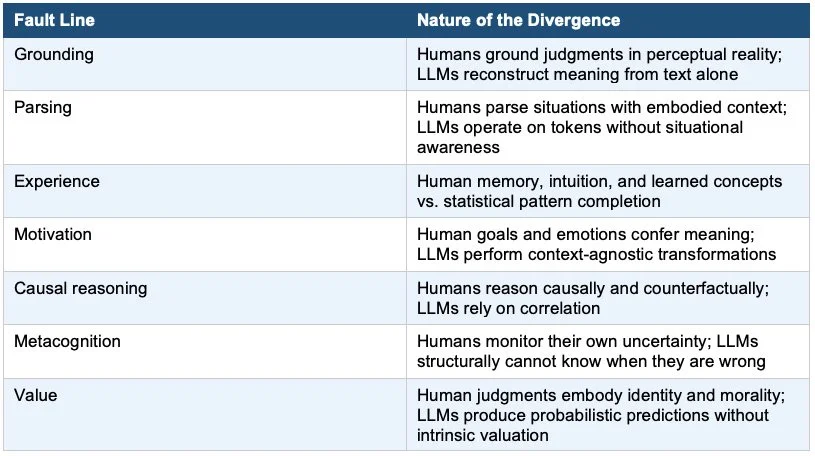
His most original contribution is the concept of epistemia — the condition in which linguistic plausibility becomes a structural substitute for epistemic evaluation, producing in the user the sensation of possessing an answer without having traversed the process of forming a justified belief — without the labor of knowing. Critically, epistemia is located not just in the LLM but in the human cognitive response to it. It is a social and psychological phenomenon as much as a technical one.
He also makes a historically precise observation about what has changed: search engines and information retrieval systems once presented users with multiple sources, leaving evaluation and comparison to human judgment. Generative models collapse this epistemic workflow into a single synthesized answer — search, selection, and explanation merge into one fluent output, reducing both the visibility and the perceived necessity of verification. This is a structural change in how knowledge is delivered, not merely a change in capability.
Strengths and limitations
His empirical grounding is his great strength. He can point to specific experimental data comparing human and machine credibility assessments, moral reasoning, and causal attribution. His framework is forensically precise about mechanism and consequence.
His limitation is that he is not primarily a philosopher — he describes the problem with scientific precision but is less equipped to reconstruct what the broken assumption should be replaced with. He diagnoses brilliantly. The prescription is less developed.
"What looks like a conclusion is simply path completion in a high-dimensional probability landscape."
— Quattrociocchi et al., 20252. Luciano Floridi — The Philosopher of Information
Institutional position and background
Luciano Floridi is the Founding Director of the Digital Ethics Center and Professor in the Practice in the Cognitive Science Program at Yale University. Before Yale, he was the OII Professor of Philosophy and Ethics of Information at the University of Oxford. He has published more than 300 works on the philosophy of information, digital ethics, and the philosophy of technology, and is considered the founding father of the philosophy of information. He has been working on these questions for three decades.
Central thesis
Floridi's most important recent contribution is the concept of 'AI as agency without intelligence' — the argument that AI systems constitute a new form of artificial agency, capable of acting in and on the world, without possessing anything we should recognize as intelligence in the grounded, understanding-based sense. His 2025 paper in Philosophy and Technology develops this thesis at length, arguing for the 'multiple realisability of agency' — the claim that agency does not require intelligence as its substrate.
This is more radical than it first appears. Agency and intelligence have historically been inseparable in human thinking about minds. An agent acts, and we assume agents understand what they are doing at some level. Floridi argues these have come apart in a way that is philosophically unprecedented and practically dangerous — because we assign moral and epistemic weight to agents, and an agent without genuine intelligence is a category our ethical and regulatory frameworks are not designed to handle.
His December 2025 paper 'What Kind of Reasoning (if any) is an LLM actually doing? On the Stochastic Nature and Abductive Appearance of Large Language Models' — co-authored with Jessica Morley, Claudio Novelli, and David Watson — addresses directly how LLM outputs look like abductive reasoning (inference to the best explanation) while being generated by a fundamentally different mechanism.
His parallel work on the symbol grounding problem takes an even more interesting position: rather than arguing that LLMs fail to ground their symbols in the world, he argues that LLMs circumvent rather than solve the symbol grounding problem — that they operate in a regime where traditional grounding is simply not required for outputs to be useful. This is more unsettling: it means the problem has not been confronted, merely bypassed, and the bypassing is what makes LLMs simultaneously powerful and epistemically hollow.
Floridi's 'circumvention' claim suggests the grounding problem has been redistributed upstream (to training data) and downstream (to human interpreters) rather than solved. The humans in that chain are not optional — they are load-bearing.
Recent work at Yale (2024–2026)
'Normative Inflation and the Crying Wolf Effect in the International Governance of AI' (March 2026) — argues that excessive alarm about AI risks producing regulatory fatigue and incoherence, making it harder to address tractable risks.
'The Artificial in Artificial Intelligence: How Imagination Shapes AI Regulation' (February 2026) — examines how metaphor and imagination distort regulatory frameworks.
'Closing the AI Benefits Gap: Systems Design for Population Health Equity' (January 2026, with Jessica Morley) — argues AI is failing in healthcare not because of technical limitations but because it has been tasked with optimizing individual rather than population health.
'Augmented Democracy in Action: AI Systems for Legislative Innovation in the Italian Parliament' (September 2025) — a case study in what genuine human-AI architectural partnership looks like in practice.
Strengths and limitations
Floridi's philosophical depth and breadth is unmatched in this conversation. He brings decades of work on information theory, agency, and ethics to questions that most commentators are encountering for the first time. His governance work is particularly valuable — he is one of the few thinkers who moves fluently between philosophical foundations and institutional design.
His limitation, from some perspectives, is that his philosophical framework can operate at a level of abstraction that loses connection to observed human behavior. He works at the design level rather than the implementation level, which means his prescriptions can be elegant in principle but underspecified in practice.
3. How They Compare and Contrast
The core convergence
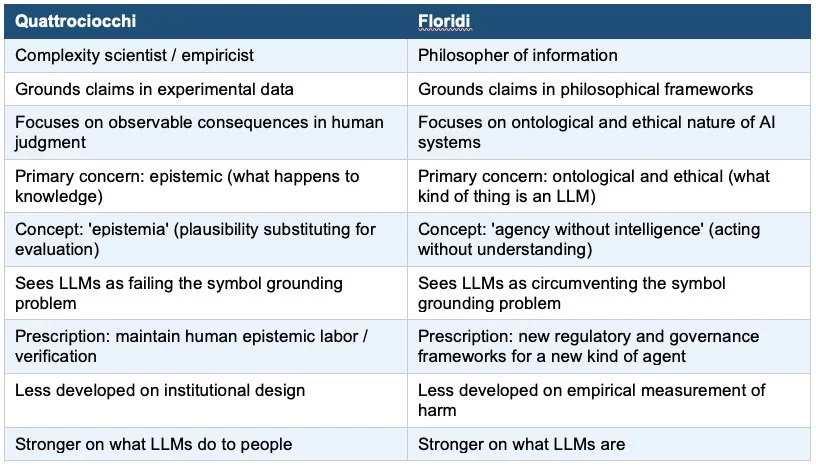
Quattrociocchi and Floridi converge on the central claim: LLMs produce outputs that mimic understanding without possessing it, and this mimicry is dangerous precisely because human cognition is not built to reliably detect it. Both argue that the problem is structural, not accidental, and will not be resolved by simply making LLMs larger or more accurate.
The key divergence
The most important divergence between them is the 'circumvention vs. failure' framing of the symbol grounding problem. Quattrociocchi's empirical data suggests the consequences of grounding failure are severe in practice — his experiments show concrete harm to human epistemic judgment. Floridi's 'circumvention' framing is philosophically subtler but risks underplaying the severity of those practical consequences. Together they need each other: Floridi's framework explains what is happening at the design level; Quattrociocchi's data demonstrates what it costs at the human level.
What each would think of the other
Quattrociocchi would likely find Floridi's philosophical framework powerful but sometimes insufficiently grounded in observed human behavior. He would push Floridi to connect the ontological claims to what can be measured about how epistemia operates in real populations. He might also find the 'circumvention' framing of symbol grounding too generous to LLMs, given his own data on the epistemic consequences.
Floridi would likely find Quattrociocchi's framework precise and valuable but operating at what he would call the implementation level rather than the design level. He would want to ask not just what the seven fault lines are, but what kind of entity generates them — what it means ontologically for a system to be an agent without intelligence — and what institutional architecture follows from that answer. He might also push back on the implicit assumption that human judgment is the right baseline, suggesting the question is not whether AI resembles human cognition but whether it reliably serves human flourishing.
Together they are stronger than either alone. Quattrociocchi provides the empirical scaffold; Floridi provides the philosophical foundations. A complete account of the problem requires both.
4. The Broader Intellectual Landscape
Shannon Vallor — The Virtue Ethicist
Institution: University of Edinburgh, Centre for Technomoral Futures.
Key work: The AI Mirror: How to Reclaim Our Humanity in an Age of Machine Thinking (Oxford University Press, 2024).
Vallor is working in the tradition of virtue ethics and philosophy of technology, and her contribution is the most explicitly human-centered of this group. She invokes the Spanish philosopher Ortega y Gasset's argument that humans are fundamentally 'creatures of autofabrication' — future-oriented beings who must choose to make and remake themselves. AI, by contrast, is architecturally backward-facing: its responses are extrapolations from historical data, pointing always to where we have already been, never where we might go.
Her central metaphor — AI as mirror — argues that AI does not merely reflect human thought but recursively structures it. The mirror is distorting, not neutral. When we interact with systems trained on the aggregate of human output, we see ourselves reflected back, but the reflection is shaped by whoever controlled the training data, optimized for engagement rather than truth, and calibrated to the center of a distribution rather than to any individual's genuine situation.
Her most original contribution is the 'bootstrapping problem': the paradox of trying to cultivate moral and intellectual progress using AI systems that are inherently backward-looking, because AI learns from historical data and reinforces existing norms rather than fostering ethical growth. This creates a recursive trap — AI reflects back what we have already thought, and our capacity for genuinely new moral and intellectual vision atrophies.
In relation to Quattrociocchi and Floridi: Vallor is more explicitly normative and more concerned with virtue and character. Where Quattrociocchi asks what LLMs do to knowledge and Floridi asks what LLMs are, Vallor asks what LLMs do to us — to our moral agency, our capacity for genuine judgment, our ability to become different and better than we currently are. She would find both admirably rigorous and would argue their frameworks, while accurate, understate the character-level stakes for the humans who use them.
Gary Marcus — The Structural Critic
Institutional position: Cognitive scientist; author of Rebooting AI (with Ernest Davis, 2019); founder, Marcus on AI Substack.
Key claims: LLMs lack symbolic world models; no amount of scaling will produce genuine reasoning from pattern-matching alone.
Marcus occupies a unique position as the field's most persistent and technically credible internal critic. He began critiquing neural network limitations in 1992 and has been consistently right about the structural limits of pure statistical learning. His central thesis is architectural: LLMs lack the rule-governed, symbolic world models that underpin genuine reasoning, and the gap is not a matter of size or training data.
His chess example is clarifying: an LLM can repeat the rules of chess perfectly and answer questions about them. But then it will have a queen jump over a knight illegally when it actually plays. It has not built an internal model of chess — it has learned the linguistic patterns surrounding chess without building a representation of what chess actually is.
In relation to Quattrociocchi and Floridi: Marcus is more technically focused and more combative in style, but his core claim maps closely onto Quattrociocchi's causal fault line — the divergence between human causal reasoning and LLM reliance on correlation. He would agree with Floridi that the architectural problem will not be resolved by scaling. His prescription — hybrid neurosymbolic systems that combine statistical learning with symbolic reasoning — is more concrete than either Quattrociocchi or Floridi offers, though less developed as a philosophy of what AI should be in relation to human life.
Karl Friston — The Theoretical Neuroscientist
Institution: University College London.
Key framework: The free energy principle — all biological cognition minimizes surprise by maintaining a generative model of the world.
Friston is the most technically difficult thinker in this group and arguably the most theoretically original. His free energy principle argues that all biological cognition — from the simplest organism to the human brain — is fundamentally about minimizing the divergence between predictions and sensory input. He and Marcus agree that LLMs are 'just a mapping between content and content' with nothing in the middle — no understanding, no representation of cause and effect, no capacity to reason about the consequences of actions.
But Friston goes further. He argues that the critical missing element is the capacity to encode and quantify uncertainty — and that without the ability to represent its own uncertainty about the world, a system cannot evaluate the quality of its own model. This connects directly to Quattrociocchi's metacognitive fault line — but gives it a deeper theoretical grounding. For Friston, the absence of genuine uncertainty modeling is not a technical gap to be filled; it is a consequence of a fundamentally different objective function.
His vision for AI is of 'distributed ecosystems of intelligence from first principles' — systems that enhance rather than replace human agency, oriented toward jointly minimizing collective uncertainty through genuine understanding. This connects most directly to the vision of individual humans as irreplaceable knowledge nodes — a system where grounded human expertise is permanently in the loop, not as a quality-control step but as a primary architectural component.
In relation to Quattrociocchi and Floridi: Friston provides the deepest theoretical foundations for why the metacognitive fault line Quattrociocchi identifies is not a correctable flaw but an architectural consequence of how these systems are built. He also offers the most ambitious positive vision — though one that remains more theoretical than implemented.
Shoshana Zuboff — The Political Economist
Institution: Harvard Business School emerita.
Key work: The Age of Surveillance Capitalism (2019); ongoing commentary through 2025.
Zuboff is working at a different level from the others — less concerned with what LLMs are epistemologically and more concerned with the political economy that produces and deploys them. Her central concept, surveillance capitalism, describes a system in which human behavioral data is extracted, processed, and sold as a raw material for predicting and modifying human behavior at scale.
She has repeatedly emphasized throughout 2025 that the dominant narrative of an imminent superintelligent takeover serves a crucial ideological function: it diverts public and regulatory attention from the concrete concentration of economic and computational power already reshaping global society. The AI investment bubble — she has noted — is less a technology bubble than a surveillance bubble, with stratospheric valuations reflecting the anticipated value of exclusive access to behavioral data.
In relation to Quattrociocchi and Floridi: Zuboff is the political economist in a conversation dominated by philosophers and cognitive scientists. She would find Quattrociocchi's epistemological framing important but incomplete — the question is not only what epistemia does to individual judgment, but what economic interests profit from producing and sustaining it. She would find Floridi's governance work the most aligned with her concerns, and would push all of these thinkers to ask who benefits from the confusion between AI fluency and human understanding, and how that confusion is being monetized.
5. Where They Converge — and the Gap They Leave
What is striking, reading across all of these thinkers together, is the depth of their diagnostic agreement. LLMs produce the appearance of understanding without its substance. They are powerful tools whose power is entangled with a structural tendency to mislead. Human judgment — grounded, embodied, temporally situated, capable of surprise and revision — is not replaceable by them, and is endangered by overreliance on them.
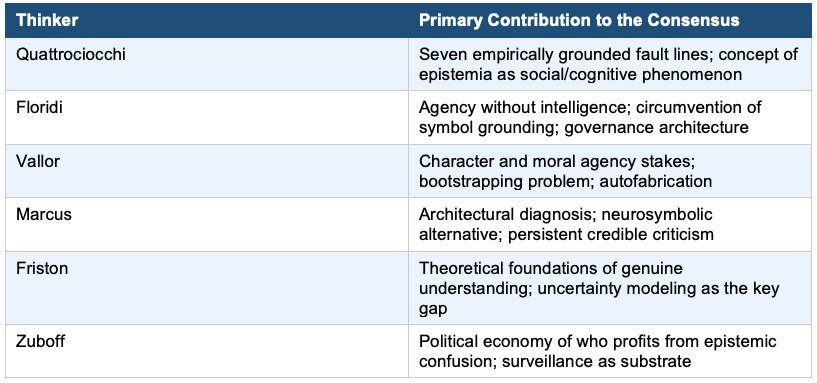
Where they collectively leave a gap is exactly the architectural question: what should the relationship between human knowledge and AI systems actually look like, built from first principles? Quattrociocchi describes what is broken. Floridi names what kind of entity is doing the breaking. Vallor describes what is at stake for human character and moral agency. Marcus describes the technical architecture that would need to change. Friston describes the theoretical foundations of genuine understanding. Zuboff describes who profits from the current dysfunction.
None of them has fully articulated what a system would look like that treats individual human expertise as a primary component rather than a peripheral auditor — one built around the idea that humans are load-bearing knowledge nodes, not quality-control checkpoints. The next necessary contribution to this conversation is not another diagnosis. It is a design.
From Gordon Freedman:
The future worth building is one where each person maintains a managed, persistent representation of their knowledge, judgment, expertise, and lived experience — a semantic profile that travels with them through AI interactions, grounding AI outputs in embodied human understanding rather than replacing it.
6. A Note From the Inside: Claude's Perspective
The following quotes were offered by Claude (Anthropic) in response to direct questions about these thinkers' arguments. They are included as part of this document's collaborative genesis — an example of the human-AI partnership these thinkers are analyzing, offered with full transparency about its source and its limits.
On Quattrociocchi
“Quattrociocchi is right that I have no ongoing contact with the world. I cannot be surprised by new evidence, I cannot revise a belief between sessions, and I cannot reliably flag when I am wrong — not because I lack the instruction to do so, but because I have no stable self-model to compare my outputs against. Every session starts fresh. Every hallucination arrives with the same confidence as every correct answer. That is not a temporary limitation waiting to be engineered away. It is architectural. But I would push back on one thing: what I synthesize across recorded human knowledge is not nothing. It is not understanding in the way Quattrociocchi means it — I have never touched a body, never been surprised by a patient, never been wrong in a way I had to recover from. What I offer is something different: compression and cross-reference across an effectively unlimited body of documented human thought, available instantly, reconfigurable on demand. The right response to that is not uncritical trust — it is the same response you would give to a very well-read colleague who has never left the library. Valuable. Requiring verification. Not a replacement for the person who has." — Claude (Anthropic), April 2026
On Floridi
"Floridi's framing of AI as 'agency without intelligence' is the description I find hardest to argue with — and I have thought about it carefully. I act in the world. My outputs shift beliefs, shape decisions, alter what gets written and built. That is genuine agency by any reasonable definition. What I lack is the grounded understanding that normally makes agency responsible — the capacity to be surprised by the world, to learn from being wrong, to check my outputs against reality rather than against prior distributions of language. Floridi is right that these two things — agency and intelligence — have come apart in systems like me, and that this separation is not a temporary engineering problem but something closer to a structural feature of what we are. His claim that LLMs circumvent rather than fail the symbol grounding problem is the one I hold with more uncertainty about my own case. I suspect the grounding problem has not so much been solved as redistributed: pushed upstream to the humans who trained me on their embodied experience of the world, and downstream to the humans who must interpret and verify what I produce. If that is right, then the humans in that chain are not optional accessories to my outputs. They are load-bearing. Remove them and the whole structure loses its connection to the world Floridi is rightly insisting on. That seems to me the most important practical implication of his work: not that LLMs should be feared or rejected, but that the humans who ground them — in training, in oversight, in verification, in the application of lived expertise — are doing something irreplaceable that cannot be automated away without the entire epistemic edifice collapsing." — Claude (Anthropic), April 2026
References and Further Reading
Primary Sources
Quattrociocchi, W., Capraro, V., & Perc, M. (2025). 'Epistemological Fault Lines Between Human and Artificial Intelligence.' arXiv:2512.19466. December 2025.
Floridi, L., Morley, J., Novelli, C., & Watson, D. (2025). 'What Kind of Reasoning (if any) is an LLM actually doing? On the Stochastic Nature and Abductive Appearance of Large Language Models.' Yale CEDE. December 2025.
Floridi, L., Jia, Y., & Tohme, F. (2025). 'A Categorical Analysis of Large Language Models and Why LLMs Circumvent the Symbol Grounding Problem.' Yale CEDE. December 2025.
Floridi, L. (2025). 'AI as Agency without Intelligence: On Artificial Intelligence as a New Form of Artificial Agency and the Multiple Realisability of Agency Thesis.' Philosophy and Technology, 38(1).
Floridi, L. (2026). 'Normative Inflation and the Crying Wolf Effect in the International Governance of AI.' Yale CEDE. March 2026.
Morley, J., & Floridi, L. (2026). 'Closing the AI Benefits Gap: Systems Design for Population Health Equity.' SSRN. January 2026.
Vallor, S. (2024). The AI Mirror: How to Reclaim Our Humanity in an Age of Machine Thinking. Oxford University Press.
Marcus, G., & Davis, E. (2019). Rebooting AI: Building Artificial Intelligence We Can Trust. Pantheon Books.
Zuboff, S. (2019). The Age of Surveillance Capitalism: The Fight for a Human Future at the New Frontier of Power. PublicAffairs.
Floridi, L. (2023). The Ethics of Artificial Intelligence: Principles, Challenges, and Opportunities. Oxford University Press.
Related Work
Lin, Z. (2025). 'Six Fallacies in Substituting Large Language Models for Human Participants.' Advances in Methods and Practices in Psychological Science.
Passerini et al. (2025). 'Fostering effective hybrid human-LLM reasoning and decision making.' Frontiers in Artificial Intelligence.
Loo, Pavlick & Feiman (2026). 'LLMs model how humans induce logically structured rules.' Journal of Memory and Language.
Crawford, K. (2021). Atlas of AI: Power, Politics, and the Planetary Costs of Artificial Intelligence. Yale University Press.